

GHOST (GUN) BUSTERS
The one’s we’re “gonna” call

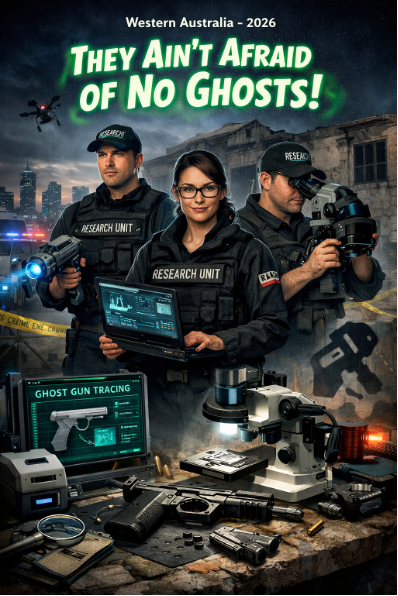
Prologue:
When the movie Ghostbusters premiered on June 8, 1984, it became an instant hit and a cultural phenomenon. Blending comedy, action, and the supernatural, the film captivated audiences, topped the box office for seven straight weeks, and became the highest-grossing comedy of its time. The story follows three dismissed University professors who, after encountering a ghost in the New York Public Library, launch their own paranormal investigation business. Operating out of an old firehouse and armed with inventive high-tech equipment, they set out to find, capture, and contain ghosts, turning skepticism into success.
Background:
Privately made firearms (PMFs), commonly referred to as “ghost guns,” are firearms produced by individuals rather than licensed manufacturers and typically lack serial numbers. While not all PMFs are illegal under federal law, and not all firearms are required to have serial numbers, their lack of serialization can make them difficult to trace. This creates investigative challenges when they are recovered at crime scenes. Between 2016 and 2021, approximately 45,240 suspected PMFs were reported to ATF as recovered by law enforcement, including 692 connected to homicides or attempted homicides. These concerns have prompted some states to enact additional laws regulating PMFs. ATF has compiled comprehensive information on the different types of PMFs and considerations when owning one. [1]
The PMF/ghost gun market continues to evolve rapidly. Early PMFs recovered by law enforcement were commonly semi-automatic pistols assembled from firearm kits, often marketed as “buy-build-shoot” kits. PMFs also include machinegun conversion devices (MCDs), which are legally defined as machineguns under the National Firearms Act, even when not installed. These devices include traditional drop-in auto sears for AR-type firearms and newer “switches” designed for certain semiautomatic pistols, both of which enable illegal conversion to fully automatic fire. Most recently, law enforcement agencies have increasingly encountered PMFs/ghost guns produced using 3D printing technology during their crime gun investigations. [2]
Blueprints for 3D-printed ghost guns are widely available online, increasing accessibility. With an affordable 3D printer and basic internet access, individuals can potentially produce unserialized firearms without going through licensed manufacturers.
As crime-related ghost gun seizures rose, so did police fears of losing vital crime gun intelligence, as these unserialized firearms are nearly impossible to trace.
New Research
A small team of PhD research scientists in Australia, armed with high-tech equipment, set out to challenge claims about untraceable ghost guns and to ease police concerns about losing valuable clues.
A recent study published in the journal Forensic Chemistry found that some filaments, the materials used in 3D printers, have distinct chemical profiles that could help link crime-related 3D-printed ghost guns to their source. Chemical analysis of the filaments may be the ticket to ending their untraceable ghost type reputation. [3]
Most 3D-printing filaments don’t list all their ingredients. Companies generally keep their exact formulas private, especially the small extra ingredients they mix in to improve strength, color, flexibility, or durability. Those small ingredients may prove to be very important in tracing crime-related ghost guns.
Even though many filaments look identical, they’re not chemically identical. Each brand and type of filament has its own unique chemical makeup, almost like a fingerprint.
Scientists can spot these differences using a technique called infrared spectroscopy. In simple terms, they shine an infrared light on a filament sample and measure which wavelengths are absorbed. Different chemical ingredients absorb that light in different ways, creating a unique pattern. That pattern can be used to tell one filament apart from another. [2]
The study in question was done in collaboration with a forensic laboratory in Western Australia. Researchers tested more than 60 types of filaments sold in regular retail stores. Many of them looked the same to the naked eye. But when tested, a large number could be distinguished from each other based on their chemical “fingerprints.” [4]
It was easy to tell apart filaments made from completely different types of plastic. More importantly, the researchers could also tell apart some filaments made from the same basic plastic because of the small, hidden additives mixed in. [3]
The takeaway is simple: even though 3D-printing filaments are common consumer products, they can still carry identifying chemical features. It suggests that components of a 3D-printed firearm could potentially be chemically “typed” and traced back to the specific filament used in their manufacture.
If investigators can differentiate between the various 3D-printing filaments, they may be able to connect a seized 3D-printed crime gun to a specific spool of filament or link 3D-printed crime guns from different cases to the same source. [3]
Making those connections could help law enforcement trace the source of the materials, identify suppliers, and disrupt the production of PMFs for criminal purposes.
So far, researchers have shown that some but not all filaments can be distinguished. Because of that, they’re continuing their work, looking at the trace amounts of metals or other foreign elements that may be present in the filaments. [3]
Conclusion
By combining multiple types of testing, scientists can build a more complete chemical “profile” of each filament. The goal is to connect a recovered 3D-printed crime gun to the exact filament used to make it and possibly even to the specific 3D printer involved.
In short, by identifying the chemical fingerprints of the materials used to fabricate 3D-printed crime guns, the PhD researchers can chip away at the idea that these weapons are untraceable and ghost-like.
To the skeptics: Bill Murray’s character, Dr. Peter Venkman, might say: “Back off, man, they’re scientists!”
End Notes:
[1] https://www.atf.gov/firearms/privately-made-firearms
[4] https://www.sciencedirect.com/science/article/pii/S2468170926000032?via%3Dihub
Super interesting, Pete. It will be interesting to see how the research progresses & if any sort of “micro-identification”, batch or lot #, could be added to a spool to better ID where/possibly to whom it was sold…
Pete, great piece. The chemical fingerprinting angle is a genuine game-changer for investigators working PMF cases. The idea that the molecular structure of a filament, essentially its DNA footprint, can differentiate one spool from another, even within the same plastic type, gives investigators a real forensic hook where none existed before. The ability to potentially link multiple crime guns back to the same filament source is exactly the kind of connective intelligence that disrupts networks, not just individual cases. Looking forward to seeing how this research matures.