



In my book, The 13 Critical Tasks: An Inside-out Approach to Solving More Gun Crime, I identified Task #1 as Managing Stakeholders.
Why is stakeholder management essential?
The reduction of violent crime is a complex problem, and the task is too large and difficult for one lab, police department, or prosecutor to manage alone. Only the right combination of stakeholders can plan and implement the improvements needed to reduce violent crime. Yet, the involvement of more stakeholders results in more diverse perspectives, which translates into more issues and requirements that need to be addressed. Success often depends on the ability to address a problem from various fronts. All of the right people involved must be thinking and acting together—not only at the outset but throughout the entire process. Plain old cooperation will not be enough to drive stakeholder management—stronger action is required. The level of action needed is best described by the word collaboration. It becomes a fundamental driver for securing a sustainable solution that delivers substantial benefits. Taking the presumptive/inside-out approach[1] to the efficient and effective investigation of gun crime begins by assembling the right groups of people and getting them to think and act together.
Stakeholder Management in Investigative Processes
To better understand why stakeholder management requires so much attention in terms of getting the people involved in the investigative process to think and act together, cut the investigative pie into three slices or phases of the process:
1. Respond to the incident and collect information and evidence.
2. Analyze the initial information collected and extract actionable intelligence.
3. Identify, arrest, and prosecute criminals.
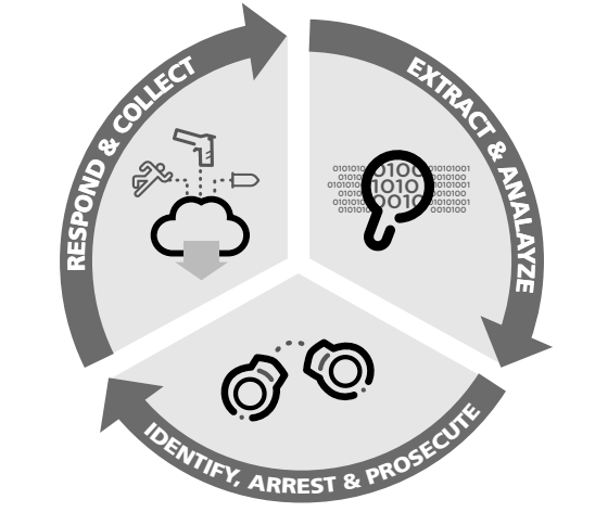
There will be different people with different job descriptions and skills working within and across each of the three investigative phases. They will often report to different chains of command and different organizations as well. For example, the response to a homicide may well involve personnel from Patrol, Crime Scene Investigation, Investigative Services, the Coroner/Medical Examiner’s Office, and the District Attorney’s Office.
Similarly, the Extract & Analyze Phase will involve people with a different set of skills than the first responders, such as forensic experts, and intelligence analysts who report to different chains of command and organizations.
The same holds true for the Identify, Arrest & Prosecute phase, especially in terms of how the Offices of the State and Federal Prosecutors coordinate actions with law enforcement officials and forensic labs. It is important to know beforehand just how all of these investigative assets will think and act together as a team. “Handshakes”, in reality, formal agreements developed in collaboration with representatives from the key stakeholder groups can help make the process most efficient and effective. These agreements can help ensure the smooth, accurate and timely “handoffs” of crucial information and evidence across the three phases. To ensure that all important information gets where it needs to go and when, any natural gaps that may exist between the phases (e.g., different chains of command, organizations, etc.) should be bridged with sustainable policies and procedures.
Diverse Stakeholders, Diverse Requirements
Different Stakeholders—Different Needs
The following quotes are taken from the Chicago Sun-Times article “Top cop McCarthy tells aldermen of plan to close three stations, redeploy officers”[2] They are attributed to Chicago Police Superintendent Garry McCarthy and his Chief of Detectives Tom Byrne. “It takes between six months and eight months to get back ballistic hits from the [state] crime lab. That’s a big problem for me because that’s basically past history. We need real-time turnaround,” McCarthy said. “If we can get ballistics matches in real-time, [Chief of Detectives] Tom Byrne is gonna have a much easier job solving those crimes. They’ll lead us to who has the guns.”
In addition to being “spot-on” accurate in terms of the value of timely information for solving gun-related crimes, their statements also give rise to the discussion of another issue related to the fact that crime solving today involves the collaboration of many stakeholders and requires a careful balance of people, processes, and technology. When it comes to ballistics data from fired ammunition components found at crime scenes, different stakeholders can have different needs. For example, forensic scientists processing ballistics data for evidentiary purposes in court must exercise careful due diligence in following certain protocols. The use and value of ballistics data as evidence in court is well established and is perhaps the use most familiar to people. Yet police investigators also rightly view ballistics data in terms of producing the actionable intelligence or the investigative leads needed to identify a suspect in the first place.
With the technology available today in networks like the National Integrated Ballistic Information Network (NIBIN), police can use ballistics data to readily link crimes, guns, and suspects across geographically separated areas (e.g., cities, states, and countries) in effect preventing criminals from escaping detection by crossing into another jurisdiction. Police recognize that for this information to be of most use—it must be generated in a timely manner.
Two stakeholders—two different missions and perspectives—add the prosecutors into the equation and we now have three missions and perspectives running on three separate tracks towards the same goal—bringing violent criminals to justice. There are even more stakeholders, the public administrators and legislators who must provide and manage the policy solutions and resources to enable effective crime fighting today and to every one of us who are affected by crime and violence. The article mentioned above provides an example of the first step: communications between stakeholders. The solution to the issues raised in the article will come when the key stakeholders sit down to think and act together to find a way in which to balance the people, processes, and technology needed to achieve the violence reduction goal they all seek.
Forming Groups
In order to assemble groups, there must be an influential senior level policy advocate or advocates to champion the concept. The champions must have the clout needed to bring the various stakeholders together in an effective spirit of collaboration and partnership. Champions can be bred along the way as part of the stakeholder management process—step one of The 13 Critical Tasks. One way of doing this is to convene two groups of key stakeholders.
Strategic Group
The first group of stakeholders is policy-oriented and should be made up of key senior managers and policymakers representing, at a minimum, three broad criminal justice perspectives: police, forensic, and prosecutorial. It is from this first group that the champions of the presumptive approach should emerge. This group should be kept as small as possible yet should represent the major police, forensic, and prosecutorial organizations at the local, county, and state levels serving the targeted affected crime region[3]. Representatives from certain federal agencies must also be included in this group (e.g., in the U.S., ATF, and the U.S. Attorney’s Office). This group must be strategically oriented and empowered to create the vision, mandate new policies, provide direction, and request resources. This group can produce multiple champions. For example, Massachusetts had several champions representing major city police organizations (the Boston Police Department, the state police, and forensic labs), the Department of Public Safety, ATF, and the state and federal prosecutor’s offices. This small group of champions had the influence and leadership required to drive law enforcement policy for the entire Commonwealth of Massachusetts.
Tactical Group
The second group of stakeholders is operation oriented and should be made up of mid-level managers, first-line supervisors, and line practitioners from the various interdependent units within the police, forensic, and prosecutorial services which have a role to play in taking the presumptive approach to the investigation of crimes involving the misuse of firearms. This second group should also consist of representatives of organizations at the local, county, state, and federal levels that serve the targeted affected crime region. This second group must be tactically oriented and must represent the various interdependent subgroups charged with enforcing the law and supporting the judicial process (e.g., patrol, investigations, special units, forensics, and prosecutors). The members of this tactically oriented group are experts at what they do. They know what is working well and what needs to be improved. They can quickly identify their people-, process-, and technology-related needs as well as the obstacles blocking their way and the gaps they must bridge. Two very different examples of the importance of influential champions in the formation of these working groups come to mind. In the first example, a simple form letter to a mayor whose city was in the process of coming to grips with increasing levels of gang- and gun-related crime, trickled down through the Police Chief to the Commander of Investigations. Instead of pushing back, the Commander kept an open mind and—while powered by the inertia created by the mayor’s referral— seized upon an opportunity to bring the various stakeholders together to discuss gun crime protocols. This effort went on to develop a very successful program which is the subject of a case study in the final chapters of this book. The other example is one in which key law enforcement stakeholders were brought together by senior state and federal officials to discuss the merits of a statewide crime gun processing protocol. One key stakeholder was immediately averse to the prospect. This was problematic because the stakeholder’s lab provided forensic services for most of the police agencies in the state. The stakeholder was concerned that more work would simply be dumped on them without regard for their capacity to respond, so he pushed back. The influential government leaders in the room assured the stakeholder that no new workloads would be imposed unless he was balanced in terms of people, processes, and technology. The stakeholder left the meeting unconvinced. A second meeting was held about two months later. This time, the recalcitrant stakeholder reported that over the intervening period between the two meetings, it was noticed that more evidence was being received and more hits were being made. The stakeholder attributed this to the common-sense messages delivered at the first meeting about the value of regional crime gun protocols. The stakeholder said, “It’s working already”. From that point on, the stakeholder who had been pushing back took the lead, asserted rightful ownership of the project, and moved it forward.
Critical Elements
Develop a senior level champion who has enough influence to drive the initiative to bring all the right people into the process.
Identify and assign participants for the strategic (policy) and tactical (operations) stakeholder groups.
Conduct a facilitated presumptive approach awareness session for the strategic stakeholder working group to generate a broader consortium of champions.
Conduct a facilitated presumptive approach protocol development workshop for the tactical stakeholder working group and transmit recommendations to the strategic group.
Plan to integrate existing programs for leveraging the presumptive approach.
Plan, develop, and implement a sustainable regional program to quickly generate crime-solving and crime-prevention benefits by taking the presumptive approach to the investigation of crimes involving the misuse of firearms.
Be prepared to communicate the new program protocols and expectations to all affected stakeholders.
Establish an ongoing process of performance monitoring between the two working groups to ensure that the initiative is well coordinated and is achieving the intended objectives.
Communicate clearly and often.
Key Considerations
Assemble the right teams of people and sustain interaction.
Clarify each stakeholder’s input and output needs.
Map the stakeholder’s current processes to identify existing bottlenecks, obstacles, and gaps.
Avoid bottlenecks that delay and hinder investigative progress.
Create new and sustainable protocols that are balanced in terms of people, processes, and technology.
Employ a continuous communication process with affected stakeholders—up, down, and across their various organizations.
Formally recognize and reward stakeholder feedback, b) increase success story collection, c) facilitate communication of the program’s value, d) heighten stakeholder motivation.
Validate the sustainability of successes through program reviews and corrective actions.
Institutionalize the new protocols within the affected organizations through policy directives.
Validate the Sustainability of Successes
Conduct program reviews to assess the sustainability of achieved outcomes. Implement corrective actions as necessary.
Formulate policy directives to institutionalize the new protocols within the relevant organizations.
Key Focus
Develop a champion, or champions that have the power to drive change at the required levels to assemble the various stakeholders needed for taking the presumptive/inside-out approach and to provide or advocate for resource support for the people, processes, and technology tools that will be needed.
Footnotes:
[1] The presumptive/inside-out approach to the investigation of crimes involving firearms presumes that there is an abundance of data both inside every crime gun, ballistic data transferred to bullets and cartridge cases, and outside every crime gun, Manufacturer identifiers, DNA, latent fingerprints, and trace evidence. This data can produce crime gun intelligence of tactical and strategic crime-solving value.
[2] Chicago Sun-Times, November 2011
[3] The affected crime region is a wide geographic area where criminals are most likely to crisscross police jurisdictions during their criminal activities (e.g., gang activity and drug trafficking).