


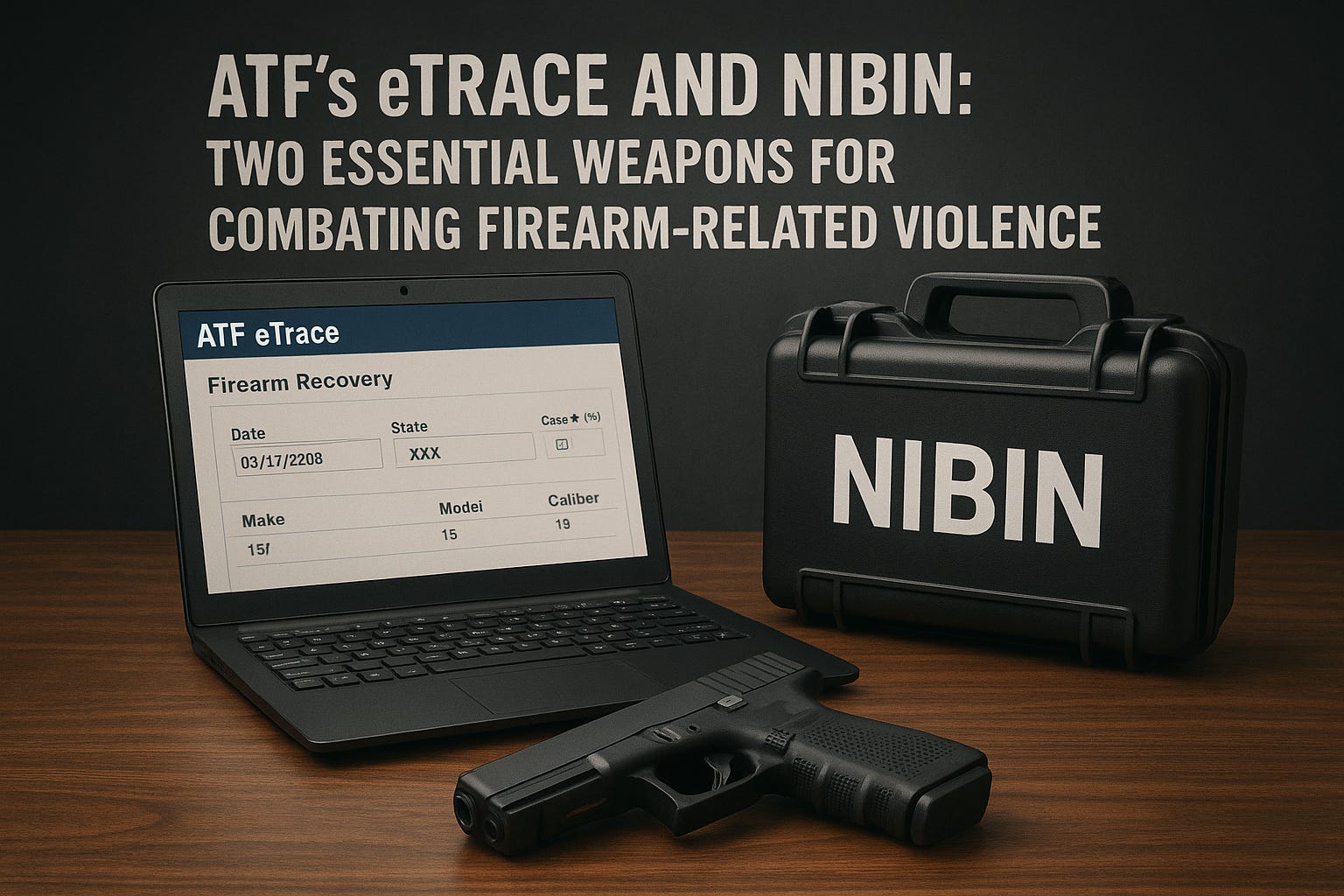
“Every Crime Gun Has a Story”
Background
ATF’s mission to protect the public from firearm-related violence relies on “Crime Gun Intelligence” (CGI), from several sources: firearm trace results from records kept by federal firearms licensees (FFLs); ballistics data from the National Integrated Ballistic Information Network (NIBIN); and investigative information from ATF agents and law enforcement partners at every level. ATF uses this intelligence to advance criminal investigations, issue bulletins, advisories, and public safety alerts.
ATF National Tracing Center
The Gun Control Act of 1968 (GCA) underpins crime gun tracing by requiring manufacturers and importers to mark each firearm and Federal Firearms Licensees (FFLs) to keep records of acquisition and disposition. These requirements allow firearms to be traced from their origin to the first retail purchaser, and sometimes beyond the first retail purchaser; these unlicensed secondary purchasers are commonly referred to as the “last known purchaser.
The ATF National Tracing Center (NTC) traces firearms associated with crimes and provides investigative leads for local, state, federal, tribal, and foreign law enforcement agencies. NTC uses leading-edge technologies and tools such as eTrace to detect firearms trafficking and trace the movement of crime guns across police jurisdictions, state lines, and international borders.
Trace data can identify suspects or traffickers linked to crime guns
Tracing can identify the initial purchaser of the firearm, providing investigators with a critical lead to reconstruct the chain of possession and determine how a lawful acquisition progressed to criminal use. Firearms tracing can also help detect domestic and international trafficking patterns and identify local trends in the sources and types of crime guns recovered.
When investigators need to quickly track down the origin of the crime gun and any possible suspects, the NTC can accept emergency requests and react very quickly.
Etrace (Internet-Based Firearms Tracing and Analysis)
eTrace is a web-based application that allows authorized law enforcement agencies to submit trace requests directly to ATF and retrieve detailed results once each trace is completed.
The benefits of eTrace include:
Robust statistical reports that readily generate new investigative leads
Faster processing of firearms trace history
Targeted trace data relevant to a specific state or local jurisdiction
Real-time data verification and case updates
Each year, ATF processes hundreds of thousands of firearm trace requests from domestic and international law enforcement. In FY 2024 alone, ATF handled nearly 640,000 requests from over 10,300 partners worldwide through the eTrace system, including cases from 52 countries. With thousands of firearms reported lost or stolen annually—many used in violent crimes—law enforcement once lacked a centralized resource for historical firearm data. Today, eTrace and the NTC provide the capability to identify the origin of a crime gun and build investigative links that lead to faster prosecution of violent offenders.
NIBIN (National Integrated Ballistic Information Network)
NIBIN processes fired evidence, such as expended cartridge cases found at crime scenes, and those test-fired from firearms recovered during police investigations. Digital images are taken from the exhibits, and their unique electronic signatures are extracted and stored in the NIBIN database. NIBIN searches the database for potentially matching signatures and sends them to trained technicians to review. The matches can help connect crimes, guns, and suspects.
“NIBIN leads are non-biased information for law enforcement personnel to assist in identifying, investigating, and arresting shooters and their source of crime guns. NIBIN technicians rely on their training and technology founded in forensic science to make ballistic connections through NIBIN. In other words, being evidence-led, NIBIN can help law enforcement determine with impartiality that a series of firearm-related crimes are connected.”
eTrace and NIBIN: a Two-Punch Combination
The following investigation demonstrates the harmonizing CGI value of: eTrace and NIBIN:
“In April of 2017, an unknown individual shot and killed a 78-year-old female at the victim’s home in Idaho. Responding officials recovered multiple fired cartridge casings at the homicide scene, which were submitted to the Washington State Patrol crime lab and entered into NIBIN. Later the same day -- in a seemingly unrelated incident -- law enforcement in Montana received a road rage complaint of someone attempting to run another vehicle off the road while pointing a firearm. Law enforcement contacted and arrested the sole occupant of the suspect vehicle and seized a pistol, which was later test-fired and entered into NIBIN. A NIBIN lead was identified through ATF’s NIBIN Enforcement Support System (NESS) linking casings from the homicide scene with test-fire from the recovered pistol. ATF provided the NIBIN lead to law enforcement in Idaho and Montana. ATF also traced the pistol and discovered the initial purchaser was the driver in the road rage incident. Law enforcement used this information as part of their follow-up investigation. Ultimately, law enforcement arrested the Montana road rage suspect for the murder of the 78- year-old female. The suspect plead guilty to Second Degree Murder and was sentenced to 15 years to life in May of 2021.”
The integration of data from NIBIN, eTrace, forensic and digital evidence, along with criminal justice records, into the CGI analysis process enhances law enforcement’s capacity to identify and prosecute armed offenders.
More on CGI and its tactical and strategic value
As stated, vital clues and information can be found both internally and externally to the firearm:
Internally, ballistic data is produced via unique markings left on fired ammunition by a gun’s mechanical parts. This data can help link a specific firearm to a single crime or a series of crimes.
Externally, identifying information—including make, model, and serial number—facilitates tracing of a firearm’s transactional history. Additionally, the surface areas of guns and ammunition can yield additional forensic evidence—such as DNA, fingerprints, and trace materials—that aid in identifying individuals who have handled or possessed a particular weapon.
Tactical and Strategic Value of CGI from eTrace and NIBIN
Tactical information is short-term intelligence offering immediate operational value in response to specific events or a series of incidents. In contrast, strategic information is compiled over extended periods and can help identify new crime patterns and trends for more accurate resource allocation and informed decision-making.
For example:
eTrace and NIBIN data possess significant tactical value:
eTrace firearm trace data identifies the initial retail purchaser, providing investigators with a foundation from which to reconstruct the chain of possession and assess how a lawful acquisition transitioned to criminal use. All to help police answer the question, who has been associated with this gun?”
NIBIN Ballistic evidence can link a specific firearm to one or more crime scenes, enabling investigators to establish connections between crimes, guns, and suspects. All to help police answer the question, what crime or crimes has this gun been used in?
The “What” and the “Who” are two of the basic questions in all detective work: What happened, and Who did it?
eTrace and NIBIN data possess significant strategic value:
eTrace firearm trace data, when collected over the long term, can help detect patterns in and trends in illegal gun markets, in terms of receivers and sources, across cities, states, and countries.
NIBIN data, when collected over the long term, can help detect patterns and trends in the types of firearms and ammunition used in crimes across cities, states, and countries. It can also help indicate the time-to-first-shooting, the time between a recovered crime gun’s last known purchase and its first shooting event.
When combined with critical case information developed by the investigating LEA, CGI from firearms can provide crucial investigative leverage. Moreover, CGI data encompasses information collected from far more sources than the firearm itself. It can come from gun fire detection systems, automatic license plate readers, cell phone locators, and private and commercial security cameras.
For example, consider the figure below, which illustrates the various sources of CGI, including the three fundamental sources: State and Local Police Reports, NIBIN, and eTrace, which form the foundation.
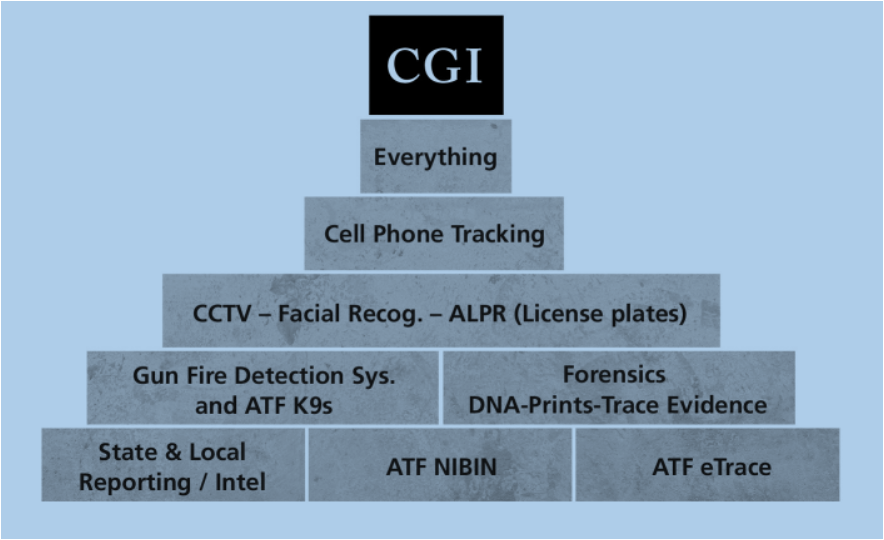
Figure sourced from: The 13 Critical Tasks: An Inside-out Approach to Solving More Gun Crime
Discussion:
eTrace and NIBIN are part of the broader ATF mission to arrest violent offenders and firearm traffickers. ATF leverages these technologies to streamline the investigative process.
Crime Gun Intelligence (CGI) enhances the concepts of intelligence and evidence-led policing by supporting the development of probable cause to identify offenders, apprehend them, and provide the court with admissible evidence to prove or disprove the facts in question.
ATF’s Crime Gun Intelligence Centers (CGIC) strive to integrate all available CGI into the CGI analysis process. Their successes have gained a favorable reputation among ATF’s other federal, state, and local partners, leading to expansion.
Notwithstanding the many other types and sources of data, information, and evidence that can and should be leveraged to generate effective CGI, the firearm and the fired evidence it leaves behind should never be overlooked as a fundamental starting point to springboard a shooting investigation.
###
Excellent article Pete!